We Designed A Culture. And That’s What Our Internship Code of Conduct Is About
By Harsh Vardhan Thakur ·
May 30, 2026. Today morning we finalized the Summer Internship Programme 2026 at Bhima Kamat – Natural Farming & Research.
The offer letters were easy.
The code of conduct took much longer.
That might sound strange.
Most organizations spend their time defining:
- roles,
- responsibilities,
- reporting structures,
- attendance,
- deliverables.
We spent a disproportionate amount of time thinking about something else:
What kind of people are required to build trust-based agricultural systems?
Because if we are trying to disrupt and improve the contemporary food system, why would we blindly follow every contemporary organizational protocol that helped create many of these problems in the first place?
Over the last five years, while building Bhima Kamat in rural Bihar, one lesson has become increasingly clear to me:
Agriculture is not primarily a production problem.
It is a systems problem.
And systems are ultimately built by people.
Not policies. Not technologies. Not funding.
People.
The quality of the system eventually becomes a reflection of the quality of the people participating in it.
That realization changed how we thought about internships.
What Farming Taught Me About Education
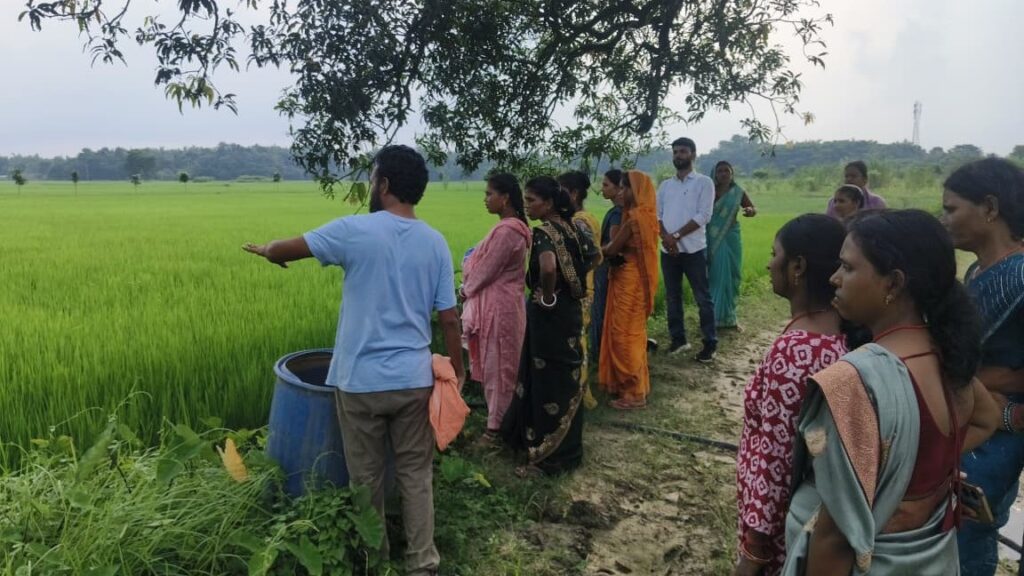
When I moved back to Bihar in 2020, I thought I was coming to learn about natural farming.
Instead, the farm became a teacher of entirely different lessons.
The storms taught resilience.
The soil taught patience.
The markets taught humility.
The customers taught accountability.
The farmers taught practicality.
And nature repeatedly taught me that everything is connected to everything else.
A crop is connected to the soil.
The soil is connected to microbiology.
Microbiology is connected to organic matter.
Organic matter is connected to livestock.
Livestock is connected to fodder.
Fodder is connected to biodiversity.
Biodiversity is connected to water.
Water is connected to trees.
Trees are connected to climate.
Climate is connected to human choices.
Nothing exists in isolation.
The same is true for people.
And yet, much of modern education still teaches subjects in isolation.
Agriculture. Business. Technology. Environment.
Separate.
Reality does not work that way.
Reality is interdisciplinary.
Reality is messy.
Reality is collaborative.
Curiosity Is More Valuable Than Compliance
One of the first principles in our internship code is simple:
“Stay curious.”
Not because curiosity sounds nice.
Because curiosity is often the difference between solving a problem and merely following instructions.
The people who helped us most over the years were rarely the ones with all the answers.
They were the ones willing to ask better questions.
Why is this crop failing?
Why is this customer not returning?
Why is this soil behaving differently?
Why are farmers hesitant to adopt a new practice?
Why does a solution work in one village and fail in another?
Curiosity creates observation.
Observation creates understanding.
Understanding creates better decisions.
And better decisions create better systems.
The Things We Have Somehow Started Taking for Granted
While drafting the code of conduct, I noticed something interesting.
Some of the most important guidelines had nothing to do with agriculture.
For example:
“Say something nice.”
Or:
“Respect people, nature and property.”
Or:
“Keep the farm better than you found it.”
At first glance, these appear obvious.
But are they?
We live in a world where:
- outrage spreads faster than appreciation,
- criticism is easier than contribution,
- consumption is easier than stewardship,
- and transactions are often valued more than relationships.
Perhaps these principles are no longer as obvious as we assume.
Perhaps they need to be stated explicitly.
Not because people are bad.
But because culture is built intentionally.
Why We Have an Unlimited Leave Policy
One section of our internship code surprises people.
We follow an unlimited leave policy.
Not because we do not care about work.
Because we care about ownership more than attendance.
A person can physically be present and mentally absent.
Another can be temporarily away while contributing tremendous value.
The real question is not:
“How many hours were you here?”
The real question is:
“What did you create, learn, improve or contribute?”
Agriculture itself does not operate on attendance sheets.
Nature rewards outcomes.
Not appearances.
Building Trust-Based Systems Requires Character
The future of food cannot be built only through better inputs.
Or better technology.
Or better certifications.
Trust-based systems require trust-worthy people.
People who:
- record observations honestly,
- admit mistakes,
- respect confidentiality,
- care for shared resources,
- communicate clearly,
- contribute to communities,
- and leave things better than they found them.
Another line from our code says:
“No written document can cover every situation.”
I believe this applies far beyond internships.
No policy can replace judgment.
No SOP can replace integrity.
No regulation can replace character.
Eventually, every system reaches a point where people must choose to do the right thing because it is the right thing.
Not because somebody is watching.
The Kind of Agriculture I Hope We Build
When people talk about the future of agriculture, the conversation often revolves around:
- AI,
- drones,
- sensors,
- carbon markets,
- traceability platforms,
- climate technologies.
Many of these developments are important.
But I believe something else deserves equal attention.
The human infrastructure.
The values.
The culture.
The relationships.
The communities.
The people who will ultimately make decisions when no textbook, consultant, policy document or AI model can provide the answer.
At Bhima Kamat, we are not just trying to grow food.
We are trying to understand how trust-based agricultural systems can be built.
The internship program is a small extension of that larger mission.
Because the future of agriculture will not be determined only by what we grow.
It will also be determined by who we become while growing it.
And perhaps that is the lesson the farm keeps teaching me, season after season.
Not just to be a better farmer.
But to become a better human being.
#NaturalFarming #Agroecology #RuralDevelopment #FoodSystems #Leadership #OrganizationalCulture #Agriculture #Bihar #CommunityBuilding #SystemsThinking