The Day We Started Taking More Than We Needed
By Harsh Vardhan Thakur ·
The Day We Started Taking More Than We Needed
There was a time when agriculture worked on a very simple principle:
Take what you need. Leave the rest for the earth.
The farmer harvested grain. The soil kept the straw, the roots, the leaves, the life.
Nothing was wasted. Nothing was extracted beyond balance.
Then something changed.
Agriculture slowly became an extraction industry.
Residue was removed. Soil was turned bare. Microbial life was disturbed. Water tables were drained. Crop diversity disappeared.
And in the process, something far more valuable than food began to decline.
The soil itself began to disappear.
The world did not break suddenly. It broke slowly — one field at a time.
The Story of a Grain of Paddy
Let us follow a single grain of paddy, coming as rice to your plate, through its life.
Not just from seed to harvest.
But from soil to your plate.
Because food does not begin in markets. It begins in the soil ecosystem.
Stage 1 — The Soil Breathes
Before the paddy is sown, something invisible begins to work.
Below the soil surface lives an entire civilization:
- bacteria
- fungi
- protozoa
- insects
- worms
- roots from past crops
Old roots slowly decompose. Crop residues soften and return to soil. Earthworms pull organic matter deeper into the ground.
This is not waste.
This is soil nutrition being rebuilt.
In natural systems, the soil is rarely naked. Living roots and organic residues keep the land covered and alive.
Every piece of organic matter becomes future fertility.
Stage 2 — Roots Become Architects
When the paddy plant begins to grow, something extraordinary happens underground.
The roots do not just absorb nutrients.
They feed the soil.
Roots release sugars and compounds that attract beneficial microbes. These microbes convert nutrients into forms plants can absorb.
Over time:
- soil structure improves
- water retention increases
- microbial diversity grows
A healthy soil becomes a living sponge and a living laboratory.
And this process begins not with chemicals — but with life interacting with life.
Stage 3 — The Field Becomes an Ecosystem
As the paddy field matures, it becomes far more than a crop field.
It becomes an ecosystem.
Birds arrive. Beneficial insects appear. Pollinators move through nearby crops.
Natural predators begin to balance pest populations.
The ecosystem returns to a state of Homeostasis
The farmer is no longer fighting nature.
The farmer is working with nature.
This is what agriculture once looked like everywhere.
And what it can look like again.

Stage 4 — Harvest Without Extraction
Harvest day arrives.
Traditionally, only one thing left the farm:
The grain.
Everything else stayed.
- Straw returned to soil
- Roots decomposed underground
- Biomass rebuilt organic matter
The soil grew richer every year.
Today, modern supply chains often reverse this logic.
Residue is burned or removed. By-products leave the ecosystem. Processing happens far away from the farm.
Slowly, soil loses the very materials that once sustained it.
A Different Way Forward
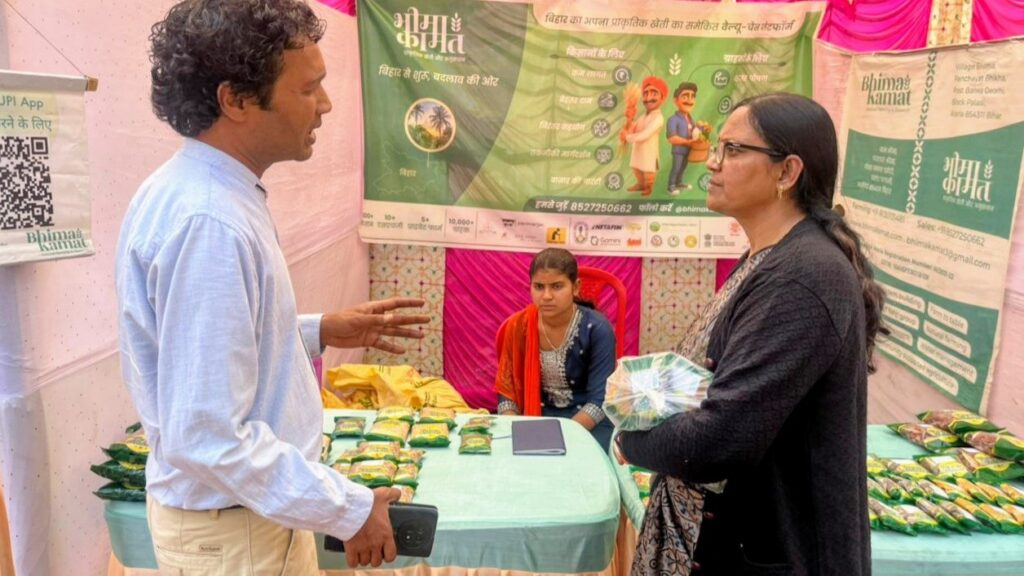
At Bhima Kamat – Natural Farming & Research, this balance is being rebuilt step by step.
The idea is simple:
Return to a system where agriculture nourishes the ecosystem it depends on.
The approach begins with soil.
Crop residues are retained. Living roots are maintained wherever possible. Organic biomass feeds microbial life.
Diversity replaces monoculture.
Fields support:
- crops
- trees
- livestock
- insects
- microorganisms
Agriculture becomes an ecosystem again.
From Soil to Village Processing
The same principle extends beyond the farm.
If soil must retain organic matter, villages must retain nutritional value and economic value.
So processing is kept as close to the farm as possible.
When paddy is milled locally:
- rice travels to consumers
- husk stays within the ecosystem
- bran can feed animals or soil
- biomass returns to agriculture
Instead of removing everything from rural landscapes, the system circulates value locally.
The result is not just better food.
It is a stronger ecosystem and a stronger rural economy.
The Real Question
The environmental crisis did not begin because humans farmed.
It began because we forgot a simple rule:
Do not take more than the system can regenerate.
Soil can regenerate.
Nature can regenerate.
But only if we allow it to.
The Future May Look Surprisingly Familiar
The future of agriculture may not depend on discovering something entirely new.
It may depend on remembering something very old.
Leave organic matter where it belongs. Let roots rebuild soil. Allow ecosystems to stabilize themselves.
Take the grain.
Leave the life behind.
And the earth will continue to feed us.
But if we keep taking everything —
one day the earth may simply have nothing left to give.