
The Stakeholder Now We Always Consider For Projects At Our Farm
By Harsh Vardhan Thakur ·
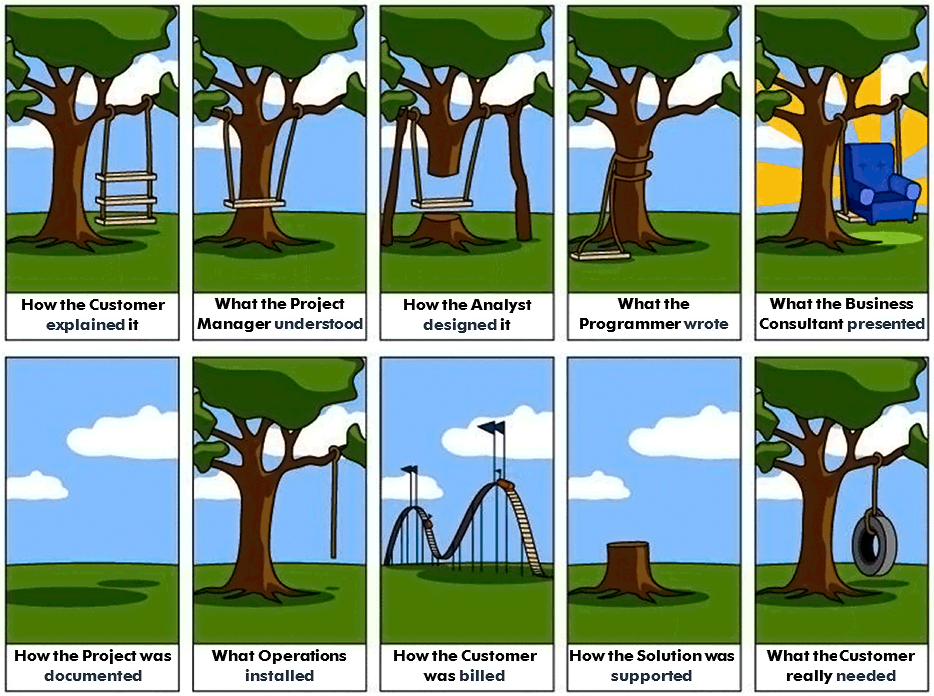
If you’ve ever worked in software, consulting, engineering, development projects—or even government—you’ve probably smiled at this famous Tree Swing cartoon:
I certainly did.
For almost a decade, it found its way into presentations while discussing stakeholder management, expectation setting and why projects often end up looking very different from what anyone originally imagined.
Every frame made perfect sense.
The customer explained something which wasn’t exactly the thing.
The analyst understood another.
The project manager balanced timelines.
The programmer built what was, if ever, documented.
Operations deployed what was delivered.
Support inherited reality.
For years, I believed this cartoon perfectly explained why projects succeed or fail.
Then I left software.
And I started farming.
Suddenly, the cartoon felt incomplete.
Not because it was wrong.
Because it was missing one stakeholder.
Every Stakeholder Was Right
One thing I appreciate much more today is that nobody in the cartoon is trying to do a bad job.
Every person is simply optimizing for the responsibility they carry.
The customer wants a solution that they don’t even know.
The analyst wants clarity.
The engineer wants feasibility.
Finance wants budgets.
Operations want stability.
Support wants maintainability.
Nobody wakes up hoping the project fails.
They simply view the same system through different lenses.
The older I get, the less interested I become in finding who was wrong.
I’m far more interested in understanding whether the system itself was designed well enough for imperfect people to succeed.
Because the reality is simple.
Systems don’t fail because people are imperfect. They fail when we design them as if perfection is a prerequisite.
That lesson has followed me far beyond software.
I’ve seen it in agriculture.
I’ve seen it in public policy.
I’ve seen it in institutions.
And perhaps most importantly, I’ve seen it on our own farm.
The Assumption Hidden Inside the Cartoon
There is one assumption inside the famous Tree Swing that I never noticed during my corporate years.
The tree never changes.
The weather never changes.
The soil never changes.
The rope never weakens.
Reality patiently waits while people finish planning.
Nature doesn’t.
Over the last six years at Bhima Kamat – Natural Farming & Research, every monsoon has behaved differently.
Some arrived early.
Some arrived late.
Some disappeared just when crops needed water the most.
Others brought intense rainfall over just a few days.
Each season quietly became another data point.
Instead of asking,
“How do we predict nature?”
we slowly started asking,
“How do we design systems that remain resilient regardless of what nature decides?”
That single shift changed almost everything.
The Stakeholder We Now Always Consider
Looking back today, I think the Tree Swing cartoon is missing one frame.
Or perhaps one stakeholder.
Nature.
Not as an abstract environmental idea.
But as an operational stakeholder.
Nature determines whether rain infiltrates the soil or leaves the farm.
Whether groundwater gets replenished.
Whether microbes thrive.
Whether biodiversity returns.
Whether the landscape becomes more resilient every passing year.
And unlike every other stakeholder…
Nature never negotiates.
It never asks for a meeting.
It never sends reminder emails.
It never requests a progress report.
Nature is the only stakeholder that never asks for a progress report. It simply reveals whether the system was designed well enough.
That sentence has become one of the guiding principles behind almost every decision we now take at Bhima Kamat.
Designing With Nature Instead of Against It
One of the biggest projects we undertook this year wasn’t buying another machine or adding another input.
It was redesigning how our farm handles water.
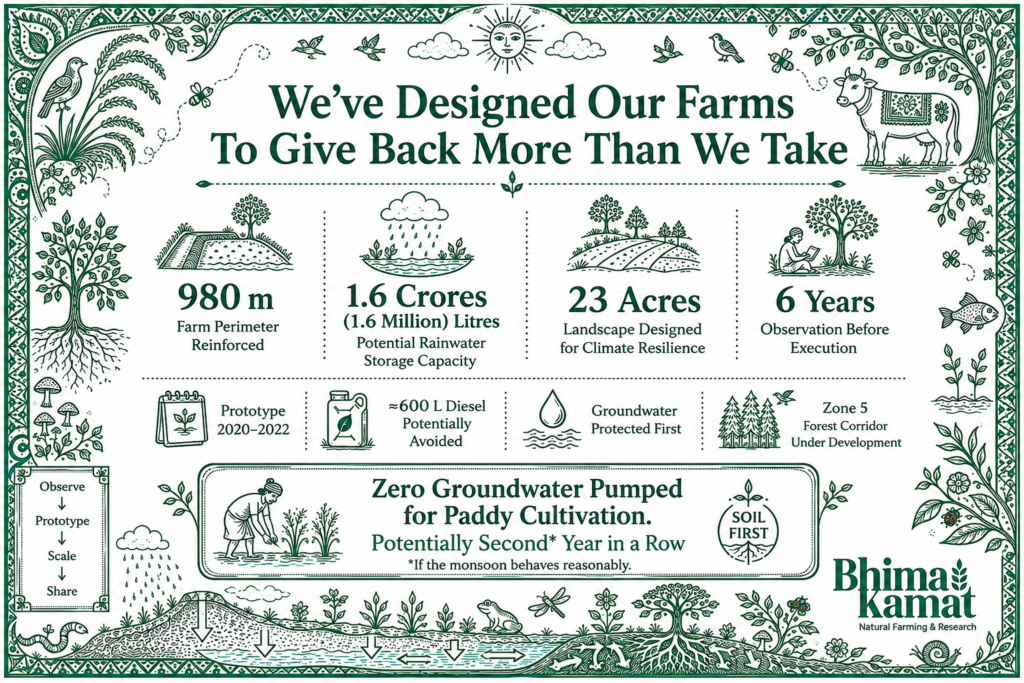
Across approximately 22.6 acres, we constructed nearly 980 metres of raised perimeter bunds, using an excavator over four days to move thousands of cubic feet of earth.
The investment was modest—around ₹30,000.
The thinking behind it took six years.
Since returning to Bihar in 2020, we have been observing our fields through every monsoon.
Where does water collect?
Where does it escape?
Which fields stay wet longer?
Which ones dry first?
How much groundwater do we end up pumping because rainwater leaves too quickly?
Farmers have traditionally repaired field boundaries every year using spades before the monsoon. It works, but it is labour intensive and often temporary.
We wanted to rethink the landscape itself.
Our design philosophy this year became remarkably simple:
Every drop of rain that falls on the farm deserves the opportunity to stay, nourish, infiltrate and contribute before it ever thinks about leaving.
Today, roughly 15 to 16 million litres of rainwater can potentially be retained across these fields before we think about pumping groundwater.
The outer boundary now allows each field to hold its own water first.
Only when one field has enough does the surplus move to another.
A landscape begins behaving like a community.
Last year, paddy establishment required diesel-powered irrigation because rainfall wasn’t sufficient at the right time.
Across the season, irrigation alone could easily cost us close to ₹80,000–₹90,000, with nearly half of that spent on diesel.
This year, there is a very real possibility that we may not need a single irrigation cycle for the crop.
That doesn’t just save money.
It means less groundwater extraction.
Less diesel burned.
More opportunity for rainwater to slowly infiltrate deeper into the soil profile.
A healthier micro climate around the farm.
And one more small step towards designing landscapes that remain productive even as weather patterns become increasingly unpredictable.
Interestingly, we didn’t solve a water problem.
We solved a landscape design problem.
The water simply responded.
When I look at the Tree Swing cartoon today, I still think it’s one of the best illustrations ever created about projects.
I just think there should be one more frame, in the context of farming systems.
Its caption would simply read:
“How Nature Responded.”
Because every project eventually leaves the meeting room.
Every drawing becomes a road.
Every spreadsheet becomes a field.
Every decision becomes part of a living system.
And reality quietly tells us whether we listened carefully enough.
As I walked along the new bund this week, I realized something.
We haven’t planted a single tree there yet.
And yet, in my mind, I can already see the forest.
Perhaps that’s a story for another time!
#NaturalFarming #SystemsThinking #RegenerativeAgriculture #ClimateResilience #WaterManagement #LandscapeDesign #ProjectManagement #Leadership #Bihar #RuralDevelopment #BhimaKamat #SoilFirst #LivingLaboratories